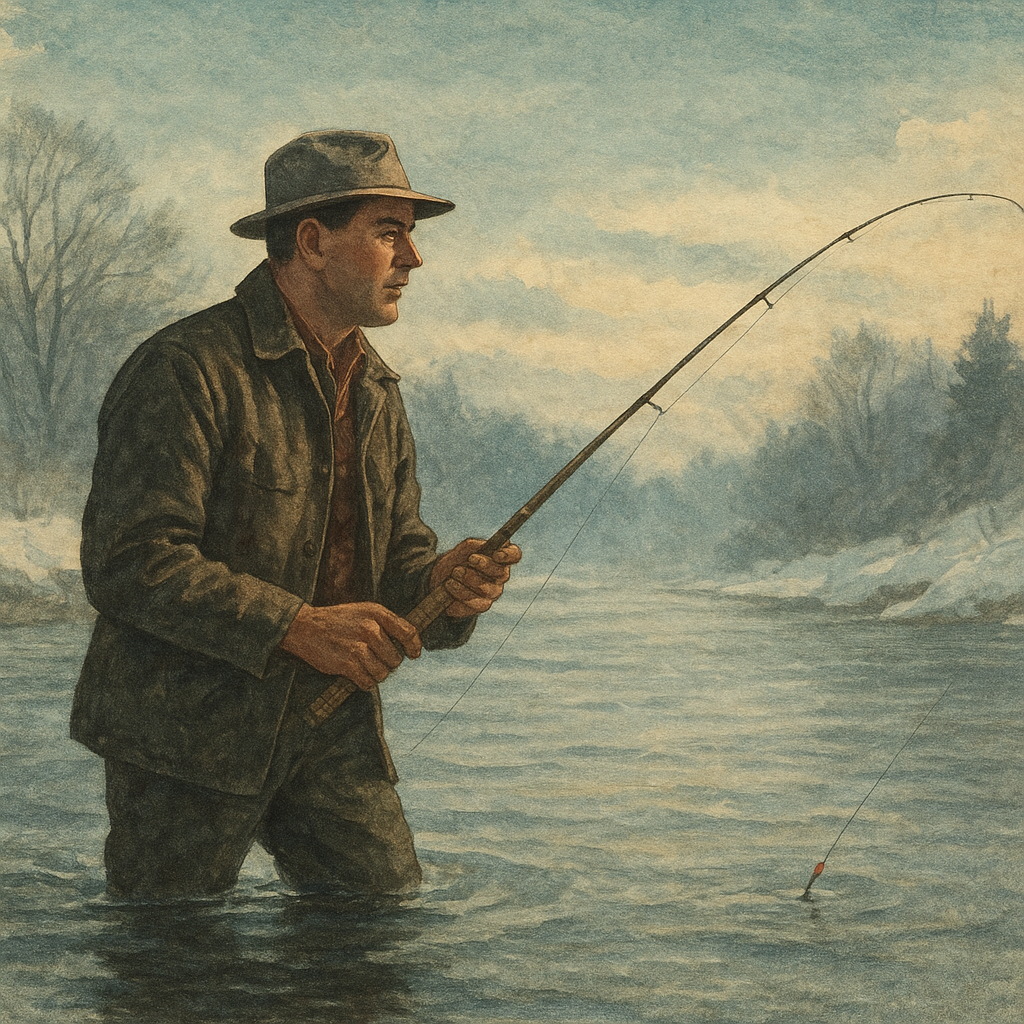
Bluebird Sky, Snow-Lined Trails: A Long Pike Morning
Dawn split the treeline with pale cold. The sky kept its blue, hard and bright. Snow lay along the banks, not deep, but enough to hint at a world rearranged. We moved along a tributary of the Great Lakes, where the current stirs, and the water wears a pale mirror. The day was quiet, almost ceremonial, a careful thing after weather that pressed in yesterday. The cold front had passed, and the air tasted of ice and possibility.
We walked the seam edges where the current curls and pushes. Small indicators drifted along the glassy line. A ribbed float, a whisper of line, a tiny sign of life. I cast once. The rod settled. The line sang in the air then slept on the water. It felt good to be back in that rhythm, to trust the feel of the rod and the weight of the lure. The pike lurk under the ice-blue glare, where the water holds the memory of winter, and the fish still believe in spring.
A long pike is a patient witness. He shows himself not in a splash but in a pressure behind the float, a pull that tugs like a remembered pain. The line drifts along the seam, a line drawn by a cautious hand. We drift small indicators, bit by bit, letting them tell us where the fish wants to live for the moment. The Great Lakes tributaries run cold and clear in this season, the current cutting like an old blade. We follow the line, not the noise. The fish chooses the moment to answer, and when he does, the air fills with a short, sharp scream of line and wind.
Under the blue sky, with the world trimmed in white and gray, we learn what a day can offer without shouting. A strike in such light carries its own gravity. It is not a celebration, but a quiet acknowledgment of place—the seam, the fish, the patient drift. The water is cold enough to bite, but not enough to stop the motion. We fish with careful breaths, with hands that know the feel of a rhythm older than the camera, older than the weather report.
The day wears on. Snow lines soften along the banks as the sun climbs the sky’s edge. We take small, deliberate casts. The indicators drift, and we read them as one would read a map in a storm. There is no guarantee here, only the work of the river and the fish who live beneath it. If a fish comes, it comes with a thought that this is where it belongs today: the seam between current and calm water, the breath between angler and river.
Gear Used
- Orvis Clearwater Fly Rod 5wt — balanced and responsive on slick seams
- Shimano Stradic FM Spinning Reel — smooth drag, dependable in cold current
- Simms Freestone Wading Boots — solid grip on icy streambed today
The day taught simplicity with a hard lesson in timing. The cold water kept us honest. We found that precision mattered more than bravado. The gear held; the line sang; the fish listened to the seam. We learned to read the water the way a hunter reads the wind—by paying attention to small shifts, to where the current bites and where it forgives.
Dawn gives way to light, and light gives way to work.